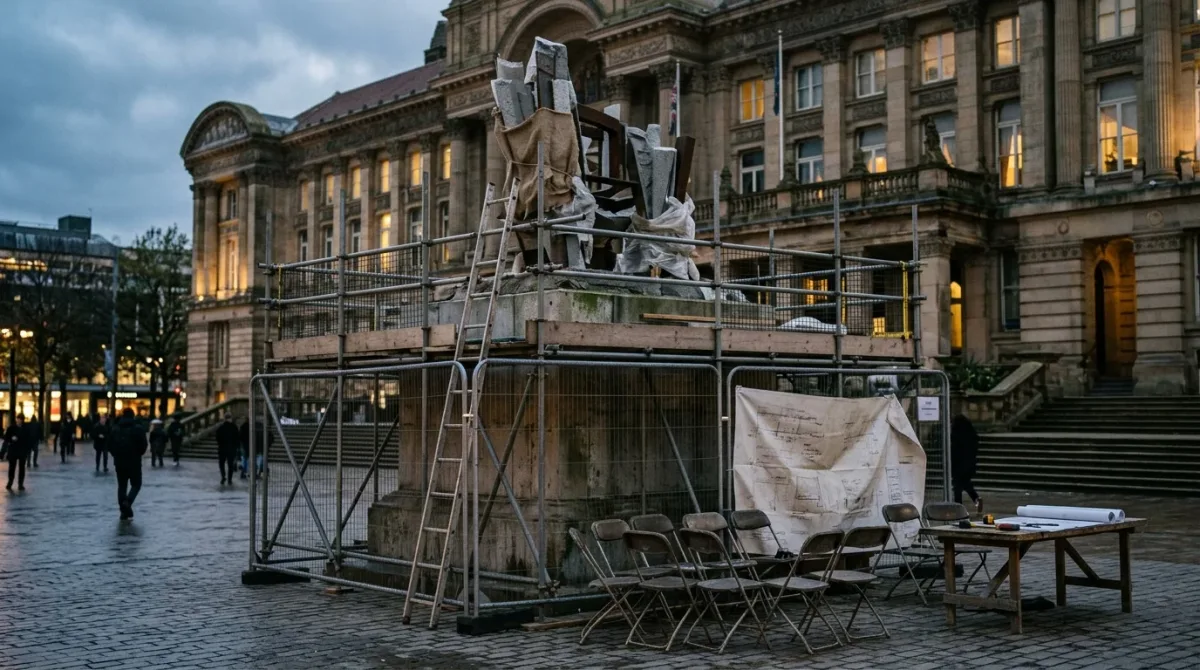
Since 1982, New York City law has required that one percent of the budget for eligible city-funded construction projects be spent on public artwork, according to the Department of Cultural Affairs, which administers the requirement. The Metropolitan Transportation Authority runs a parallel arrangement, spending up to one percent of the funds for station rehabilitation on permanent art.
Between them, the two programs account for a large share of the artwork New Yorkers encounter without setting foot in a museum: the mosaic on a subway platform, the glass in a station windscreen, the sculpture outside a new civic building. Neither is a commission in the older sense of a patron approaching a favored artist. Both are procurement processes, with open calls, budget formulas, voting panels, fabrication inspections and, for permanent work on city-owned land, a separate design-review body with the power to send a proposal back.
What does the Percent for Art law actually require?
It requires that one percent of the budget for eligible city-funded construction projects be spent on public artwork, a rule in force since 1982 and managed by the Department of Cultural Affairs. The department says the law has produced hundreds of site-specific projects in painting, lighting, mosaic, glass, textiles, sculpture and new technologies.
The legislation passed the City Council in 1982 and was signed by Mayor Edward I. Koch, according to a Percent for Art case study published by the city. Administration of the program was not immediately the department's own: the Public Art Fund ran it from 1983 to 1986, after which the Department of Cultural Affairs assumed full responsibility. The two qualifications that matter most to anyone reading the rule for the first time are in the wording itself. The project must be city-funded, and it must be eligible; the one percent is not a levy on construction in the city at large.
How large is a Percent for Art budget?
The formula is tiered rather than flat. The city's case study describes an allocation of no less than one percent of the first twenty million dollars of an eligible project budget, plus no less than one half of one percent of any amount above twenty million. Allocations need not exceed $400,000 per commission.
What the artist receives is a fraction of that figure, because the allocation covers the object and everything required to make it exist. Documents prepared by the Department of Design and Construction for a September 2025 artist information session on a city recreation center project set the art budget at roughly $730,000 and divided it as follows: 20 percent artist fees, 60 percent fabrication and installation, 10 percent materials, tools and labor, and 10 percent general expenses, documentation and contingency. Individual project budgets and splits differ; the arithmetic is not a fixed schedule.
Who chooses the artist?
A panel does, and its composition is prescribed. The city's case study describes panels made up of three art professionals, one of whom must be an artist, together with representatives of the Art Commission, the sponsoring city agency, the borough president's office, the local council member's office and the community board.
More recent project documents show how that translates into votes. For the 2025 recreation center commission, the Department of Design and Construction listed voting members as a Department of Cultural Affairs representative, a Design and Construction representative, a Parks representative and three public arts professionals, with architects, program staff, the Public Design Commission, borough and council representatives, community organizations and members of the public attending in an advisory capacity. Artists reach the panel through an open Artist Directory rather than by invitation. Eligibility, per the same materials, is broad: professional visual artists or artist teams working in any medium, at least 18 years old and authorized to work in the United States, submitting an artist statement and biography of no more than 550 characters each, a website link and 10 to 15 images.
What happens between selection and installation?
Selection is itself two-stage. The 2025 project materials describe a first panel meeting that names finalists and alternates, an orientation at which finalists receive site plans, fabricator resources and draft contracts, and a second panel meeting some weeks later at which each finalist presents a site-specific proposal and the panel votes on the commission.
Finalists are paid a $500 honorarium from the Department of Cultural Affairs for the proposal development phase — a reminder that most of the design work in a public art competition is done by people who will not be commissioned. After selection come contracting, fabrication with inspections at the 50 percent and 100 percent marks, installation and final acceptance. The sequence explains why the gap between an announcement and an unveiling is routinely measured in years rather than months.
How does the subway commission its art?
Through a separate program with a similar logic. MTA Arts & Design commissions permanent work using up to one percent of Capital Program funds allocated to station rehabilitation, and the authority says the works are made in the materials of the system — mosaic, ceramic tile, bronze, steel and glass — and sited in station walls, gates, windscreens, plazas and architecture.
Artists are chosen competitively. The authority posts open calls, takes submissions through an online platform and convenes selection panels of arts professionals and community representatives. It describes a permanent collection of more than 400 works by world famous, mid-career and emerging artists, a figure it states on its own pages and which grows as stations are rebuilt.
| Percent for Art | MTA Arts & Design | |
|---|---|---|
| Administered by | Department of Cultural Affairs | Metropolitan Transportation Authority |
| Funding basis | One percent of eligible city-funded construction budgets, tiered above $20m | Up to one percent of Capital Program funds for station rehabilitation |
| Stated ceiling | Need not exceed $400,000 per commission | Not stated on the program pages |
| Route in for artists | Open Artist Directory, then panel invitation | Open calls, online submission platform |
| Panel | Voting agency and arts professionals, advisory community members | Arts professionals and community representatives |
Which artworks need Public Design Commission approval?
Permanent artworks on city-owned property do. The Public Design Commission states that it does not review artworks installed for less than one year, though anything expected to stand beyond 365 days should be submitted before installation — a threshold that quietly decides whether a temporary piece is a permitting matter or a design-review matter.
Review runs in stages. A conceptual submission comes first, when an artist can present an idea without finished drawings; preliminary review follows once the design is fully developed, and approval at that stage is what allows fabrication and installation to proceed; a final submission is made after installation, with archival-quality photographs. Amended conceptual and amended preliminary submissions are required if a design changes significantly, and an extension of approval if the schedule slips. Monuments and memorials face additional tests. The commission discourages memorials to subjects recognized as significant for fewer than 20 years unless the case is exceptional, will not consider memorials to living persons, and requires a professional historian to establish the subject's significance and verify proposed text and images.
Has the process drawn criticism?
It has, most visibly over who is consulted before a work is approved. In March 2015 the arts publication Hyperallergic reported that Council Member Jimmy Van Bramer and the then cultural affairs commissioner, Tom Finkelpearl, had drafted legislation requiring one or more public hearings on proposed works and advance notice of planned commissions on the department's website.
The report characterized the existing arrangement as decisions taken by a committee of city officials and local art experts behind closed doors, and traced the bill to the dispute over a proposed sculpture by the artist Ohad Meromi in Long Island City. That account describes the position in 2015; readers should not assume the drafted measure reflects current law, and the status of any such legislation is a matter for the City Council's own records. The episode is nonetheless the clearest public statement of the tension the system carries: a procurement process designed to be insulated from lobbying is also, by construction, one the public watches from outside.
Practical details
Percent for Art: administered by the New York City Department of Cultural Affairs; artists enter through the program's Artist Directory. Full program terms are published on the department's Percent for Art pages. MTA Arts & Design: permanent commissions for the transit system, with opportunities posted as open calls on the authority's site. Public Design Commission: reviews permanent artwork on city-owned property. Budgets, panel compositions, submission requirements and deadlines are set project by project and are subject to change; confirm current terms with each agency before relying on them.
For a related art news perspective, read How New York decides which artist gets a public art commission.