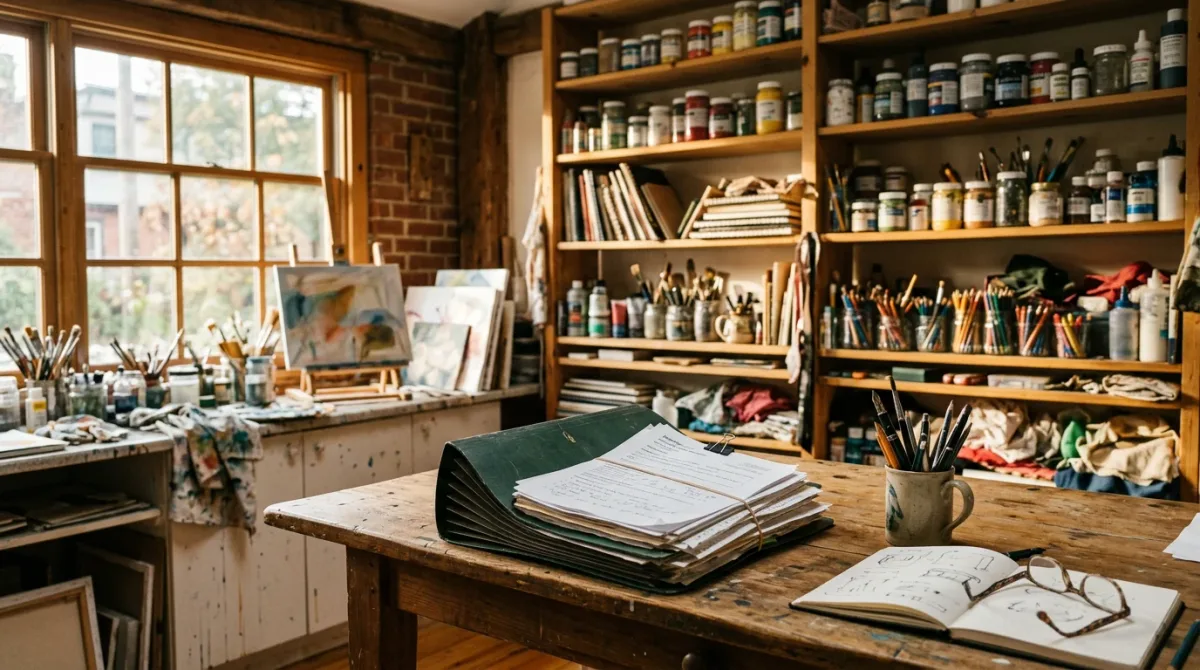
Chashama's Space to Create program rents artist studios as small as 94 square feet across the Bronx, Brooklyn, Manhattan, Queens, New Jersey, and parts of upstate New York, and the organization says spots are "not merit-based" — any working artist can apply regardless of résumé or medium. That single fact cuts against the usual math of studio-hunting in this city, where a rented corner of a warehouse can run an artist thousands of dollars a month before a single piece sells. For artists trying to keep a practice alive here, three organizations do more of the unglamorous, load-bearing work than most gallery press releases ever will: Chashama, the New York Foundation for the Arts, and the city's own Materials for the Arts warehouse.
None of these programs is a secret, exactly. But the way they interlock — cheap space, fiscal infrastructure for grant money, and free supplies — rarely gets laid out in one place for artists who need all three at once.
What does Chashama's Space to Create program actually offer?
Chashama leases underused real estate from property owners and turns it into studios and presentation space for artists, with units running from 94 to 500 square feet depending on what's available at a given site. According to Chashama's Space to Create program page, tenants get more than a room: access to an annual open-studio event, exhibition opportunities, networking with other resident artists, and access to Materials for the Arts through Chashama's own nonprofit membership. There's no jury of the artist's portfolio — the program states plainly that space is granted on a not-merit-based basis, which is unusual in a field where almost every opportunity involves a competitive application.
The catch is availability, not qualification. Chashama does not list a running total of open studios on its site, and the group directs prospective tenants to follow its social media and subscribe to its newsletter to learn when specific locations open up, alongside a direct application on its website. In practice, that means the program rewards artists who check in repeatedly rather than those who apply once and wait.
How does NYFA's Fiscal Sponsorship help artists pay for space and materials?
Space is only half the equation — most artists still need money to sustain a studio practice, and grant funders overwhelmingly want to write checks to a 501(c)(3), not an individual. That's the gap the New York Foundation for the Arts' Fiscal Sponsorship program is built to close. Under NYFA's model, an individual artist, collective, or even an LLC can apply as an "Artist Project" and, once accepted, use NYFA's own nonprofit status to accept tax-deductible donations and apply for grants that require fiscal sponsorship — all without incorporating as a nonprofit themselves.
NYFA's published terms are specific: a one-time $150 contract fee, a $150 annual renewal, and an administrative allocation on funds raised through the sponsorship that starts at 8 percent for the first $500,000 and steps down as revenue grows. Applicants have to show a defined project with a public audience and a plan to raise at least $15,000 in contributed income through NYFA. The foundation runs four free application cycles a year plus a year-round out-of-cycle option with an additional $175 fee, and it says decisions typically arrive within four weeks of a deadline. For an artist trying to fund a body of work, a residency stipend, or the buildout of a shared studio, that infrastructure — not a single grant — is often the more durable resource. Sponsored artists also get a dedicated project page on NYFA's website with its own donation portal, and can run crowdfunding campaigns through the platform Seed&Spark while still offering their donors a tax deduction. Groups that incorporate as nonprofits rather than applying as individual Artist Projects — NYFA calls this track "Emerging Organizations" — pay an additional $45 quarterly maintenance fee on top of the same contract terms.
Where can artists get free supplies through Materials for the Arts?
Once an artist has space and a way to raise money, the next line item is materials, and here New York runs one of the odder pieces of municipal infrastructure in the arts world. Materials for the Arts, operated by the city's Department of Cultural Affairs with the Department of Education, collects surplus goods donated by businesses and individuals and redistributes them at no cost — but only to nonprofit organizations with arts programming, city agencies, and public schools, according to the program's page on the city's own website. Individual artists working solo do not qualify directly, which is exactly why Chashama's own MFTA membership matters: it's one of the ways an individual studio artist ends up with access to the warehouse's inventory anyway, through a sponsoring nonprofit. A separate nonprofit called Friends of Materials for the Arts works alongside the city agency, helping run the warehouse's day-to-day operations and its educational programming — one more reason the program runs less like a city office and more like a working reuse center with regular shopping hours.
The scale of the operation is larger than its low profile suggests. Hyperallergic reported that MFTA's membership base tops 4,500 organizations, that the program runs out of a 35,000-square-foot warehouse in Long Island City with a staff of 20, and that it diverted more than eight million pounds of material from landfills over a two-year period, with the diverted goods valued at more than $40 million. The inventory ranges from fabric, frames, paint, and hardware to leftover materials from Broadway and film productions — supplies that Hyperallergic noted have turned up in exhibited work, including pieces by artists shown at institutions like MoMA. Founded in 1978 by the artist Angela Fremont, the program predates almost every other item on this list, which is its own argument for why it's worth knowing about.
What should artists know before they apply?
None of these three programs is a straight line from application to solved problem. Chashama's spaces depend on what property becomes available and where; NYFA's sponsorship comes with real, published fees that eat into whatever gets raised; and Materials for the Arts is built for organizations, which means an unaffiliated artist typically needs a nonprofit relationship — a sponsoring gallery, a Chashama tenancy, or a NYFA-sponsored project — to get through the door. Stacked together, though, the three cover the three things a working artist actually needs in order: a room, a way to legally raise money for what happens inside it, and the physical stuff to make the work.
What ties them together isn't marketing. It's that all three organizations were built, at different points over the last five decades — Materials for the Arts in 1978, NYFA not long after, Chashama in the 1990s — specifically because the market wasn't going to solve this on its own. An artist starting from zero has a reasonable order of operations: look into Chashama first, since it requires no fundraising and no nonprofit affiliation to apply; build a NYFA-sponsored project once there's a defined body of work and a fundraising goal attached to it; and treat Materials for the Arts as a benefit that tends to arrive once one of those other relationships is already in place, rather than a first stop on its own.
For a related artists perspective, read How Do NYC Grants for Individual Artists Actually Work?.