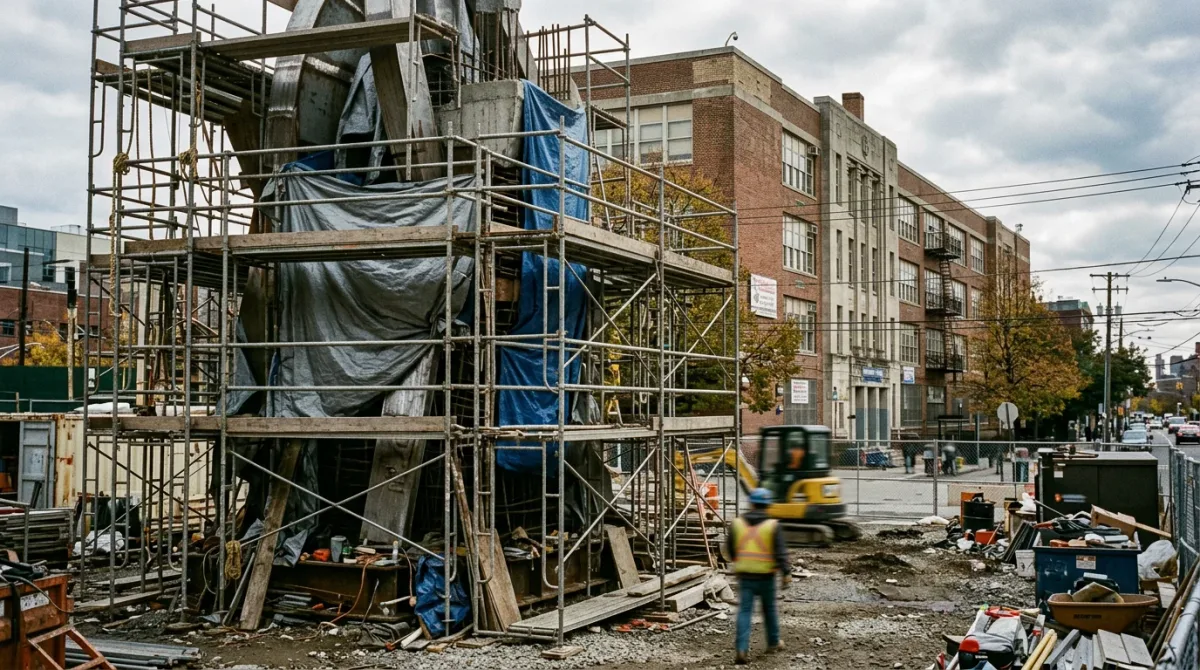
New York City has required its own construction projects — public schools, firehouses, courthouses, recreation centers — to set aside money for original art since 1983, and that one law, known as Percent for Art, has funneled more than $65 million into commissions for working artists across the five boroughs, according to the city's Department of Cultural Affairs.
For artists patching together income from teaching gigs, art handling shifts, and the occasional gallery sale, a city commission is one of the few payments in the field that comes with a fixed budget, a public paper trail, and no gallery cut. It is also, by design, slow, bureaucratic, and easy to misunderstand from the outside. Here is how the mechanism actually works, what it has paid out, and where it has drawn real opposition.
What exactly does the Percent for Art law require?
The law, passed by the City Council and signed by Mayor Ed Koch, took effect in 1983 and requires that eligible city-funded construction projects set aside at least 1 percent of the first $20 million of the project budget, plus at least half a percent of anything above that, for artwork. No single commission's art allocation can exceed $400,000, and that money has to cover everything — the artist's design fee, fabrication, installation, transportation, and insurance, not just a sculpture's sticker price.
The law applies to city-owned buildings across all five boroughs: public schools, courthouses, day care centers, police precincts, firehouses, hospitals, transportation terminals, detention facilities, and parks. The Department of Cultural Affairs administers the program and runs the artist-selection process for each qualifying project.
How much has the program actually paid artists?
As of the city's 2024 accounting, marking the law's 40th anniversary, Percent for Art had completed more than 450 projects citywide, with more than 100 additional commissions in progress, and an accumulated value of over $65 million in today's dollars. To mark the anniversary, the department also launched an interactive map cataloguing 40 works — 34 already installed, six previews of pieces still coming.
Some of the artists who have passed through the program have gone on to major recognition: Amanda Williams and Olalekan Jeyifous, who collaborated on the piece "Our Democracy Our Destiny," are MacArthur Fellows; Jeffrey Gibson became the first Indigenous artist to have a solo exhibition in the U.S. Pavilion at the Venice Biennale, in 2024; Hank Willis Thomas has since received the U.S. Department of State's Medal of Arts. Sculptor Ursula von Rydingsvard, another artist with work in the program, put the case for it plainly in a 2024 statement released by the department: "The Percent for Art program is a crucial part of our city as it allows more people to experience art."
How does an artist actually land one of these commissions?
Each project gets its own selection panel, not a standing committee. The panel includes three art professionals — at least one of whom must be a working artist — plus representatives from the city's Art Commission, the sponsoring agency, the borough president's office, the local City Council member's office, and the community board. An architect hired for the building presents the project to the panel and can suggest specific artists or concepts, but it is the panel that recommends the artist, the site within the building, or the artwork itself, weighing the proposal against the neighborhood and the building's function.
A recent example shows how granular this gets in practice. For a new 67,000-square-foot recreation center planned for Roy Wilkins Park in St. Albans, Queens — with a gymnasium, an indoor track, a pool, and fitness rooms — the city's Department of Design and Construction held an artist information session in September 2025. The rec center's total budget ran about $730,000, with at least $100,000 of that set aside for art: 20 percent for the artist's fee, 60 percent for fabrication and installation, and 20 percent held as contingency.
The eligibility bar for that call was narrow but not exclusionary by discipline: any professional visual artist or artist team, working in any medium, at least 18 years old and authorized to work in the United States. Artists joined a directory by emailing an artist statement (capped at 550 characters), a bio, and 10 to 15 images to the department, ahead of a September 19, 2025 deadline. A first panel meeting followed in early October, an orientation for shortlisted artists in mid-October, and a second panel meeting in mid-December to pick finalists — who each received a $500 honorarium just to develop a site-specific proposal before any commission was awarded. That particular window has closed, but the department runs this same sequence — directory, panel, orientation, proposal, second panel — for every qualifying project citywide, on a rolling basis.
Has the process ever set off a real fight?
Yes, more than once. In 2015, a Long Island City sculpture by Ohad Meromi, titled "Sunbather," became a flashpoint after cost estimates for the piece ranged from $370,600 to $515,000, Hyperallergic reported — a range whose upper end would have blown through the program's own $400,000 per-artwork ceiling had it held. A member of the local community board dismissed the sculpture as looking like "Gumby's grandmother," and artist Hunt Rodriguez made protest art of his own, captioning it with the claim that the city had spent "$450,000" on a piece that "cost $350 Dollars to make," according to Hyperallergic's account.
The backlash fed a bill introduced to the City Council by then-Councilman Jimmy Van Bramer, with backing from then-Cultural Affairs Commissioner Tom Finkelpearl, that would have required public hearings and advance online notice before any new Percent for Art installation — a response, as Hyperallergic framed it, to a selection process that had been running "behind closed doors." The outlet's report placed the fight in a longer local history of contested public art in the city, including Richard Serra's "Tilted Arc" — a 120-foot steel wall installed at Foley Square in 1981 by the federal government, just before Percent for Art began, and removed less than a decade later at a cost Hyperallergic called "a $175,000 blunder" — and three John Ahearn sculptures that Percent for Art itself commissioned for the South Bronx in 1991. Those Ahearn pieces drew outrage from the mostly Black local community, which read them as racist, according to Hyperallergic's account, and the city took them down after just five days, at a cost of roughly $100,000.
Why this matters beyond the check
Grant deadlines and residency cycles get most of the attention in conversations about how New York artists actually get paid. Percent for Art is less visible — a line item buried in city construction budgets — but it is one of the few funding streams tied by law to the cost of building itself, which means it keeps generating new commissions as long as the city keeps building schools, firehouses, and recreation centers. That is not a small thing for artists working outside the gallery system: it is public money that has to go to an artist, by law, whether or not the resulting work makes anyone comfortable.
For a related art perspective, read How New York City's Percent for Art Law Pays Working Artists.
For more context, read How New York City's Percent for Art Law Pays Working Artists.