SITE Santa Fe has announced the theme and full artist list for its thirteenth edition, which runs June 11, 2027 through January 10, 2028. Titled “There Are Other Worlds,” the exhibition is curated by Ekow Eshun and gathers forty-two artists. According to Artforum, the curatorial statement frames the show as an argument that art can offer “alternative ways of seeing, relating, and imagining.”
The announcement matters less as a roster reveal than as a statement of method. Biennials increasingly compete on framing rather than scale, and SITE Santa Fe—the New Mexico biennial now entering its thirteenth iteration—has chosen a structure that makes its argument visible before a single work is installed. The exhibition will be divided into three sections, each carrying a distinct charge: “Worlds Beyond,” inspired in part by the Transcendental Painting Group; “World in Common,” which explores community-building among artists; and “Worlds Alive,” centered on connections between flora, fauna, and humans. Readers tracking the wider exhibition calendar can follow how such thematic fairs and biennials shape the season in the publication's exhibitions coverage. For related coverage, see Fifteen unhinged things said to independent artists, and what they reveal. For related coverage, see Fifteen unhinged things said to independent artists, and what they reveal.
What the three-part structure signals
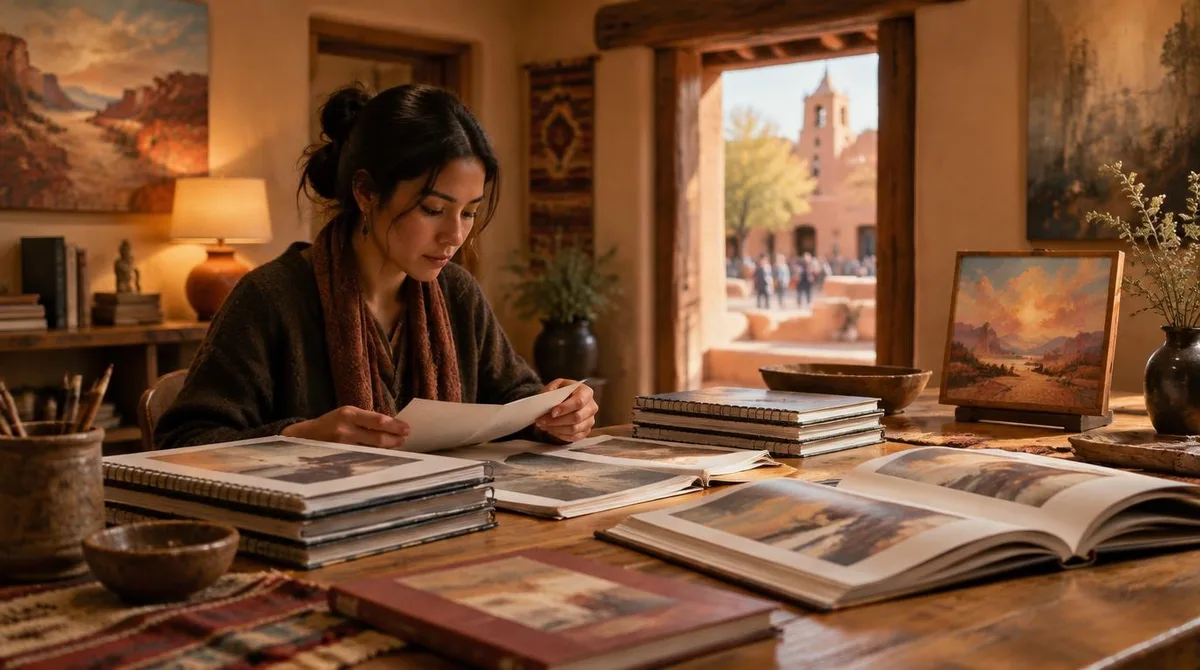
Dividing a biennial into three named sections is a curatorial choice with consequences. It tells visitors how to move, and it tells artists what conversation they are joining. “Worlds Beyond,” drawing on the Transcendental Painting Group—a historical touchstone for abstraction aimed at the metaphysical—suggests the edition will reach back into a Southwestern lineage rather than treat New Mexico as neutral ground. “World in Common” turns toward process and collectivity. “Worlds Alive” extends the frame past the human, a direction that has moved from the margins of large exhibitions toward their centers in recent years.
According to the curatorial statement quoted by Artforum, the through-line is perceptual: “Uniting these practices is a shared sense that the world is never singular or fixed, but continually reshaped by how we perceive, imagine, and relate to one another.” The statement continues: “There Are Other Worlds invites us to look beyond existing realities to consider how alternative ways of being might come into existence.” That is an ambitious brief, and the three-section split reads as an attempt to keep it from dissolving into vagueness—each section gives the thesis a concrete register: the mystical, the social, and the ecological.
Who is on the list, and why the commissions matter
The forty-two-artist roster mixes figures with long international exhibition histories and artists whose practices sit closer to the edition's themes. Among the participants are John Akomfrah, Sanford Biggers, Frank Bowling, Olafur Eliasson, Nan Goldin, Shilpa Gupta, Sky Hopinka, Arthur Jafa, and Tavares Strachan. The full list also includes Hurvin Anderson, Ellen Gallagher, Jeffrey Gibson, Tomashi Jackson, Bharti Kher, Cannupa Hanska Luger, Michael Namingha, Rose Simpson, Zineb Sedira, Carmen Winant, and others named in the announcement.
The more telling detail, for anyone reading how the edition will actually take shape, is the commissioning list. According to Artforum, new commissions by Edgar Arceneaux, Firelei Báez, Raven Chacon, Lotus L. Kang, and Cauleen Smith indicate that at least part of the show will be made for Santa Fe rather than assembled from available works. Chacon's inclusion in a section structure that runs from transcendental abstraction to human–ecology relations gives the thesis a local register. Commissions also signal institutional confidence: they cost more, take longer, and commit the organization to outcomes it cannot fully preview at announcement stage.
For readers who want context on how artists move from studio to institutional platform, the publication's artists coverage follows these careers across seasons, and the broader news picture sits in art news. This connects to our earlier piece, Houston artists take the floor as Untitled Art Fair returns with 98 galleries. This connects to our earlier piece, Houston artists take the floor as Untitled Art Fair returns with 98 galleries.
Why this announcement reaches beyond Santa Fe
A biennial announcement is a positioning document. By stating its theme, sections, and artist list ahead of the June 2027 opening, SITE Santa Fe—according to the Artforum report—is doing three things at once: securing attention in a crowded exhibition economy, giving participating artists' galleries a long runway, and setting the interpretive frame before critics do. The title itself—declarative, plural, unapologetically speculative—positions the edition against readings of the present as fixed. Whether the show earns that framing is a question only the installation can answer.
What the evidence establishes is the scope: forty-two artists, three sections, five named new commissions, a named curator, and a run of roughly seven months from June 11, 2027 to January 10, 2028. What remains unknown is how the sections will be weighted, how the commissions will answer the curatorial statement, and how the Transcendental Painting Group reference will function in practice—as historical context, as formal cue, or as something else entirely. Those questions resolve only on site, in 2027.
What visitors should watch for next
Between now and the June 2027 opening, the useful signals will be logistical and interpretive: venue arrangements, section assignments for individual artists, and any further commissioned works added to the list. Visitors planning around the run would do well to treat the announced dates as the fixed frame and everything else as subject to refinement as the edition develops.