Gallery representation means a commercial gallery agrees, on an ongoing basis, to exhibit and sell a living artist's new work—the primary market—typically on consignment with a commission customarily split around fifty-fifty between artist and gallery. When a work is resold afterward, at auction or through a dealer, it enters the secondary market, where the artist generally receives nothing under United States law. Between those two mechanisms sits most of the economics of a contemporary artist's career.
The arrangement matters to more than artists. What a visitor sees in a Chelsea or Tribeca gallery, who is in a museum biennial, and why a particular canvas costs what it does at auction all trace back to decisions made under representation agreements that are rarely discussed in public.
What does a primary gallery actually do?
A representing gallery does not usually buy work outright. It takes paintings on consignment: the artist keeps title, the gallery shows and stores the work, and the artist is paid only after a sale closes, with unsold work returned. Industry references put the customary commission at about fifty percent for two-dimensional work, with ranges of roughly thirty to fifty percent depending on the gallery's services and the medium. What the split buys is everything around the sale—exhibitions, art-fair booths, catalogue production, collector cultivation, and the storage and shipping between them.
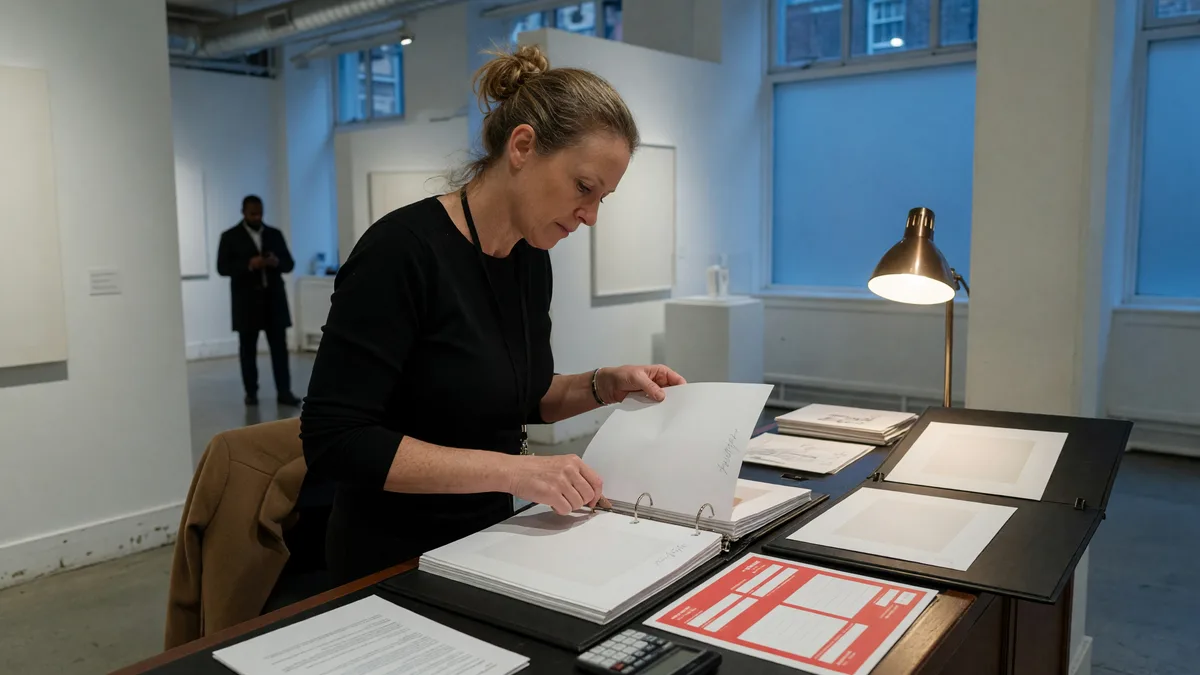
The services behind that split are the invisible half of a gallery's program: a New York gallery will commonly mount a solo exhibition for each represented artist on a cycle of a year or two, place works with collectors between shows, and bring the program to the major fairs—all before any single sale pays for the season. Representation also implies exclusivity in practice. A gallery's stable—its roster of represented artists—functions by territory and by price level, with the primary gallery controlling first sales and the waiting lists that form around a sought-after artist. David Zwirner's relationship with Yayoi Kusama, maintained since 2013, is a public example: the gallery stages her exhibitions, prices new work, and places it with collectors and institutions on the artist's behalf.
How is the secondary market different?
Once a work has been sold the first time, resales run through auction houses and secondary-market dealers rather than through the artist. Prices at that stage answer to provenance, condition, and demand rather than to a gallery's price list. The gap can be vast: at Sotheby's in New York on May 18, 2017, Jean-Michel Basquiat's Untitled (1982) sold for $110.5 million, then a record for an American artist at auction—a price assembled entirely without the artist's estate or any primary gallery in the transaction.
The secondary market is also where representation changes hands visibly. When an artist's auction results outrun the primary gallery's prices, representation moves, rosters reshuffle, and the primary market reprices—which is one reason galleries guard their artists' placement so closely.
What changes when an artist switches galleries?
A move resets the machinery. The new gallery inherits—or rebuilds—the waiting list, rehangs the artist in its program, and usually re-prices new work upward if auction results support it. The old gallery may retain older inventory on consignment, and museum curators recalibrate which fair booths and exhibitions the artist will appear in. For collectors, the practical signals are the announcement itself and the first solo exhibition under the new flag; for the artist, the difference is who answers the phone when a museum calls.
None of this is regulated pricing. Commissions, exclusivity terms, and consignment protections vary by agreement and by state; New York's arts statutes protect artists' title to unsold consigned work, and artists are advised to put every term in writing before the crate leaves the studio. What is stable across the system is the division of labor: the primary gallery builds the artist's first market one studio exhibition at a time, and the secondary market—impersonal, auction-driven, and far richer once it ignites—decides what the earlier work is worth to everyone else.